
MCM at EMAC 2026 in Bath
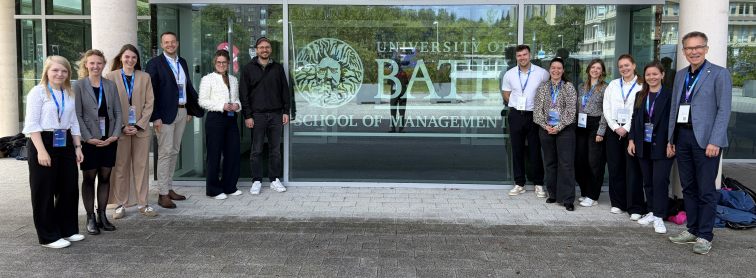
From June 2nd until June 5th 2026, the EMAC Spring Conference was held at the University of Bath, bringing together marketing scholars from across Europe and beyond. Once again, the MCM was well represented – with contributions spanning topics such as pop-up stores, brand rivalry, customer relationship management, sales strategy, pricing, virtual and augmented reality in marketing, as well as the use of text and language in consumer research.
As a pre-conference event, Mara Leonie Konduscheck (IfM) took part in the EMAC Doctoral Colloquium (May 31 – June 2), which gives selected doctoral students in marketing the opportunity to present and discuss their dissertation research with peers and leading academics.
During the main conference, MCM scholars presented across a range of tracks and sessions. Nadine Eckel contributed a paper to the track on Language, Content, and Consumer Response. Frederik Ferié and Eliza Starke presented their work on competitive positioning, examining when positioning a brand against large competitors may not be the most effective strategy. Lena Kamp explored the link between brand personality and pop-up store visits, while Madeleen van Veen presented research on text-to-price sensitivity, drawing on user-generated content to model price responsiveness in FMCG markets. Konstantin Müller shed light on the value potential of virtual training for management and marketing, and Isabel Sophie Münch presented her conceptualization of sales strategy as a firm-level construct, including an investor valuation perspective. Maren Lowis contributed to a special session on making VR research work in marketing, addressing both the opportunities and methodological challenges of VR-based studies.
Two special sessions further showcased MCM expertise. Prof. Dr. Manfred Krafft co-organized the CRM SIG Special Session on "Customer Acquisition and Retention: From Predictive to Causal Approaches." Keynote talks by Harald Van Heerde and Aurélie Lemmens anchered the session – Van Heerde illustrated how the circumstances of customer acquisition shape long-term customer value, while Lemmens traced the evolution of retention research from predictive towards ML-based causal methods. Prof. Dr. Sebastian Hohenberg participated in the Marketing Strategy SIG session on "Evolution of Marketing Strategy Research: Reflections and Research Frontiers," sharing career reflections alongside fellow scholars, with Jan-Benedict Steenkamp opening with a field-level perspective and Kapil Tuli moderating a closing roundtable.
As in previous years, Bath offered ample opportunity for informal exchange – rounding off a productive conference presence for the MCM.