

Rethinking Customer Service Digitalization: Incongruent Frames and Alignment Mechanisms in Retailing
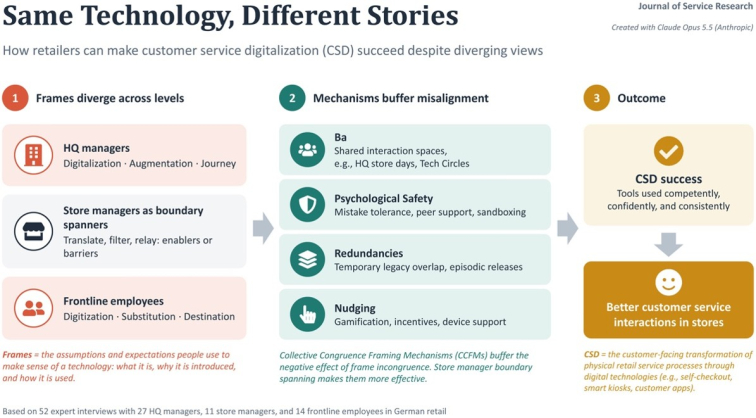
A new study by Jürgen Kai-Uwe Brock, Madeleen van Veen, Victoria Kramer, and Manfred Krafft, published in the Journal of Service Research as part of a special issue on Organizational Frontlines, examines why customer service digitalization (CSD) initiatives can lose momentum on the retail shop floor despite strong corporate support. Based on Technology Framing Theory and fifty-two expert interviews with headquarters (HQ) managers, store managers, and frontline employees in German retail, the authors show how differing interpretations of CSD across organizational levels can hinder its use in stores.
The study identifies three core framing gaps. HQ management tends to see CSD as digitalization, a broader service transformation, while frontline employees often see it as digitization, the replacement of analog tools with digital ones. HQ views digital tools as human augmentation, whereas many frontline employees fear substitution and job loss. And HQ treats CSD as an iterative journey, while frontline employees expect a finished product and experience unpolished releases as disruption. A fourth gap concerns store managers themselves, who are framed by HQ as enablers and by some frontline employees as barriers.
To buffer the consequences of incongruent frames, retailers use four collective congruence framing mechanisms: shared, cross-hierarchical spaces for knowledge exchange (Ba), psychological safety, redundancies, and nudging, which should encourage service-relevant use rather than mere compliance. Store managers’ boundary spanning strengthens how well these mechanisms work in practice.
Success is defined as competent, confident, and consistent use of digital tools by store employees, not mere adoption. Better customer service interactions follow from it.
The full article is available open access here. https://doi.org/10.1177/10946705261498173